Search


23 Jan 2026
Search
23 Jan 2026

Please allow ads as they help fund our trusted local news content.
Kindly add us to your ad blocker whitelist.
If you want further access to Ireland's best local journalism, consider contributing and/or subscribing to our free daily Newsletter .
Support our mission and join our community now.
To continue reading this article, you can subscribe for as little as €0.50 per week which will also give you access to all of our premium content and archived articles!
Alternatively, you can pay €0.50 per article, capped at €1 per day.
Thank you for supporting Ireland's best local journalism!

It would be “foolish” to assume that Donald Trump will not threaten tariffs again during his tenure, Ireland’s deputy premier has said.
Simon Harris said Europe came “extraordinarily close” to an economic catastrophe this week after the US president threatened to impose tariffs on six EU nations, the UK and Norway from next month over opposition to the US taking over Greenland.
Mr Trump withdrew the threat after announcing a framework deal on Arctic security at Davos, Switzerland, on Wednesday night.
Mr Harris said that despite this, “fundamental issues of concern” remain and warned that it was a “wake-up call” for Europe.
“We have seen a situation where in a very short period of time, the threat of additional tariffs on European Union member states was levied, and indeed for the first time, the conflation of trade tariffs with sovereignty and with territory.”
He said he had asked officials in the Department of Finance to carry out economic “scenario planning” and said the EU needed to “really accelerate actions to become more self-reliant” on defence and the economy.
“It would be a brave person to try to predict the president of the United States’ mind in relation to this,” he told reporters at Government Buildings in Dublin after a trade forum attended by industry figures.
“I would certainly hope not. I think we have seen on two occasions now where the United States engaged in a degree of adventurism around tariffs.
“We have seen the need for the United States to actually step back and take stock.
“We saw it the first time where they had to put the 90-day pause in place because the markets intervened, and you saw a real impact on American workers in terms of their own pensions, in terms of terms of their own economic security.
“And then you saw it this week, where there were threats of tariffs and threats, indeed, of potential annexation of European territory, and a walk away from that as well.”
He added: “I think it would be foolish to presume and depend on this never happening again.
“(Canadian) Prime Minister (Mark) Carney, I think, spoke for many people in Davos when he talked about the fact that there is now somewhat of a new world order and the old international norms that we’ve all been operating on for a generation and more is certainly tested at best.”
He also defended the bloc’s approach to defending Greenland against US threats of annexation, after Ukrainian President Volodymyr Zelensky said during a speech at the World Economic Forum summit in Davos that “Europe looks lost” and still does not know how to defend itself.
“I have great respect for President Zelensky, I certainly don’t think that’s what happened,” he said.
“I actually think what happened this week was the European Union maintaining its nerve control head, sticking together, and making it very, very clear that if those tariffs were levied, we would respond in an unflinching manner.
He said the EU’s approach not to respond in a “knee-jerk manner” was “somewhat vindicated”.
“(We) condemned it and made it clear that if it was anything more than random musings, there’d be very significant economic responses, and we got to a point where the president of the United States backed down, quite frankly, and changed his position in real time.”
Foreign Affairs Minister Helen McEntee said the EU’s relationship with the US was “the most important relationship it has”, though the last few months has “certainly tested that”.
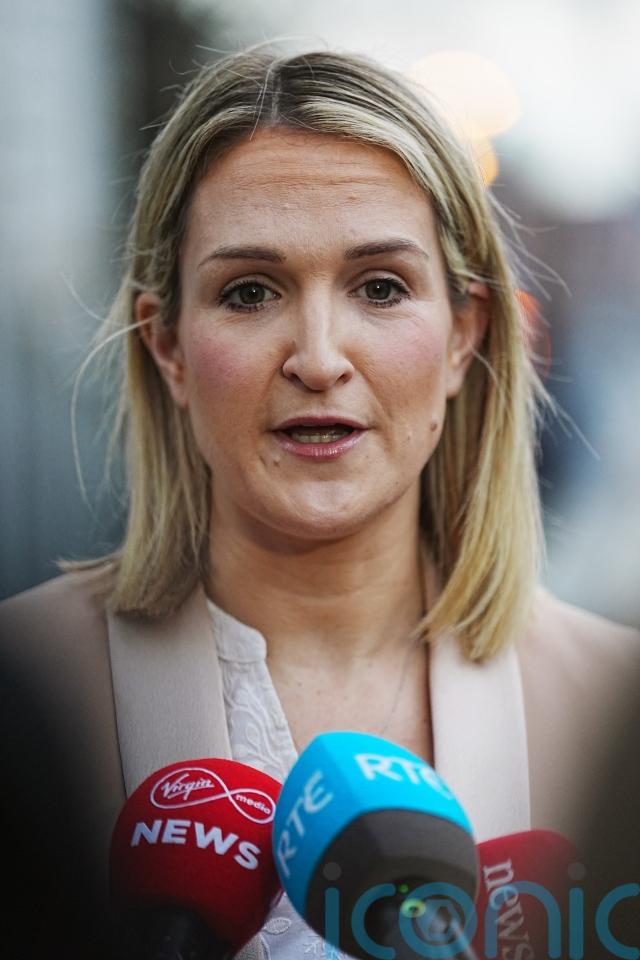
She said Ireland would continue to look at diversifying its markets abroad in the wake of Mr Trump’s tariff threats, and would use St Patrick’s Day trips to build on that aim.
“It’s about expanding our footprint in many economies, whether it’s in India, whether it’s in China, whether it’s further afield in Australia,” she said.
Despite the tumultuous week, she said the Irish premier should still visit the White House for St Patrick’s Day.
“It’s an opportunity for us to grow a relationship that has existed for many decades. It’s a relationship that I know our European colleagues value and want us to continue,” she said.
“Washington is just one of (the countries we travel to), but it’s a really important visit in the overall context, and certainly something that we’re not going to pull back from.”
Mr Harris and Ms McEntee also said that the government was agreed in its approach on whether to join Mr Trump’s so-called Board of Peace.
The board approved by the UN in November had expected to be a small group of figures overseeing the ceasefire in the Middle East, but it appears to have evolved into a wider organisation.
Ms McEntee said they had sought clarification on whether the group could focus on peace in Gaza and on the one billion-dollar “price tag” for joining.
“We cannot join a structure that essentially will try to mimic or undermine the UN Security Council,” she said.

Subscribe or register today to discover more from DonegalLive.ie
Buy the e-paper of the Donegal Democrat, Donegal People's Press, Donegal Post and Inish Times here for instant access to Donegal's premier news titles.
Keep up with the latest news from Donegal with our daily newsletter featuring the most important stories of the day delivered to your inbox every evening at 5pm.

This publication supports the work of the Press Council of Ireland and Office of the Press Ombudsman, and our staff operate within the Code of Practice of the Press Council. You can obtain a copy of the Code, or contact the Council, at www.presscouncil.ie, Lo-call 1800 208 080 or email: info@presscouncil.ie.